 Daomaker
Daomaker increases airdrop allocation by converting Boost contributions from USDT to DAO
Daomaker offers an airdrop Boost option that converts a USDT contribution into DAO to increase the participant's allocation of project tokens. After the airdrop period ends, the participant must claim the DAO manually. Classic contributions return USDT automatically. These choices affect both allocation weight and the asset held during participation. The amount returned is separate from the project-token reward, which follows its own release conditions. Boost therefore combines a larger allocation with DAO price exposure. Comparing the options requires keeping contribution quantity, market value and reward timing distinct, especially when project tokens have a vesting schedule.
Returning a Boost contribution in full preserves its DAO quantity, while its USDT value moves with DAO's price.
USDT conversion and allocation weight
The size of a USDT contribution affects its allocation, while selecting Boost changes the asset and weighting attached to that contribution. Boost swaps the participant's airdrop contribution from USDT into DAO. The conversion price determines the DAO quantity held during participation. A different price can produce a different token quantity from the same starting USDT amount.
The shared public-offering model measures allocation weight with shares. Classic contributions receive one share per USDT. DAO contributions receive six shares per DAO when one DAO equals one USDT, with a price adjustment otherwise. Shares are weighting units, not withdrawable project tokens. The final allocation also reflects contributions across the pool. Increasing an individual's weight doesn't specify their payout in isolation, and greater allocation weight doesn't multiply the DAO quantity available for return.
The contribution balance and the airdrop reward
The contribution balance concerns the capital committed for participation; the airdrop allocation concerns the project's reward tokens. They represent different assets even when both belong to the same campaign.
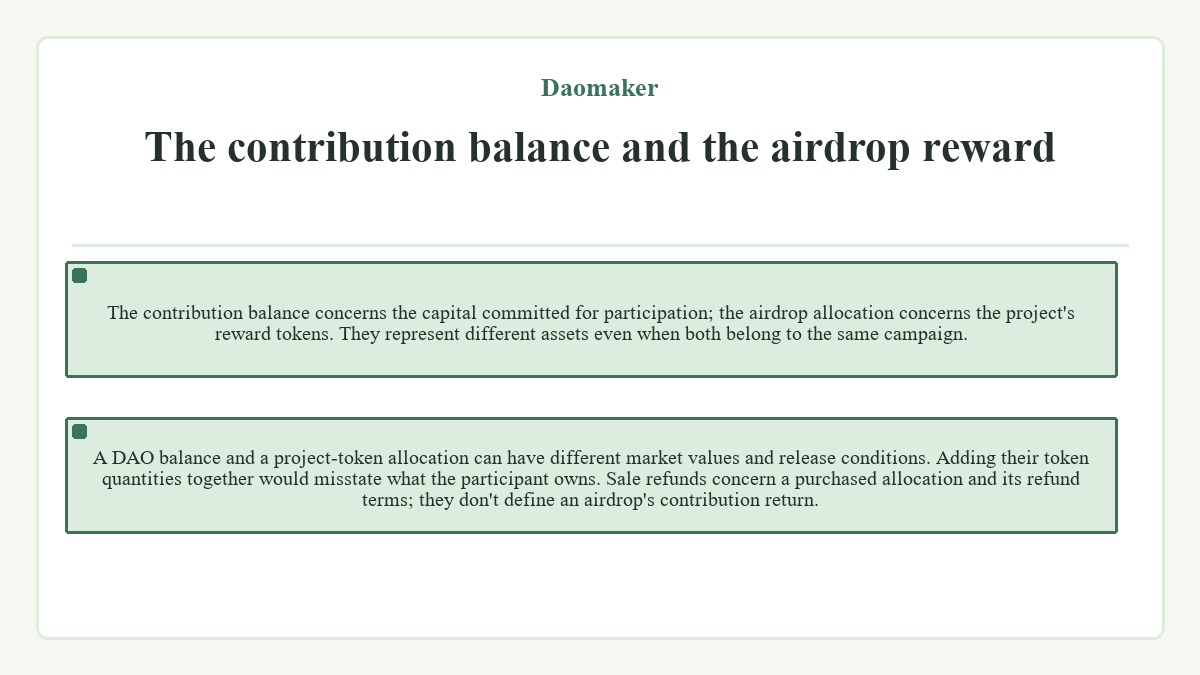
A DAO balance and a project-token allocation can have different market values and release conditions. Adding their token quantities together would misstate what the participant owns. Sale refunds concern a purchased allocation and its refund terms; they don't define an airdrop's contribution return.
The manual DAO claim
After the airdrop period ends, Boost participants must manually claim their DAO on the contribution page. An ended participation period doesn't itself mean that the wallet has received the returned DAO. This claim concerns the contributed asset, so it doesn't also settle the project's airdrop reward. A project's ongoing vesting can leave reward tokens unreleased after the contribution return.
Does a full DAO return preserve the original USDT value?
A full DAO return preserves token quantity, while its USDT value changes with the DAO price. Recovering the starting USDT value therefore requires comparing the value of returned DAO with the original contribution.
Assume a hypothetical contribution of 738 USDT, an entry conversion price of 1.23 USDT per DAO and a later price of 0.91 USDT per DAO. Ignore conversion costs for this calculation. Dividing 738 by 1.23 gives 600 DAO. A full return delivers those 600 DAO; valuing them at 0.91 USDT per DAO gives 546 USDT.
The returned quantity is intact, while its valuation is 192 USDT below the original contribution. That 546 USDT figure is a valuation, not USDT that the claim sends to the wallet. The project's airdrop reward sits outside this calculation, so no reward value offsets the difference here. Classic would keep the contribution denominated in USDT. A different entry or later DAO price changes the comparison; converting returned DAO into USDT would also involve the terms and costs of that separate exchange.
Classic deposits as the alternative
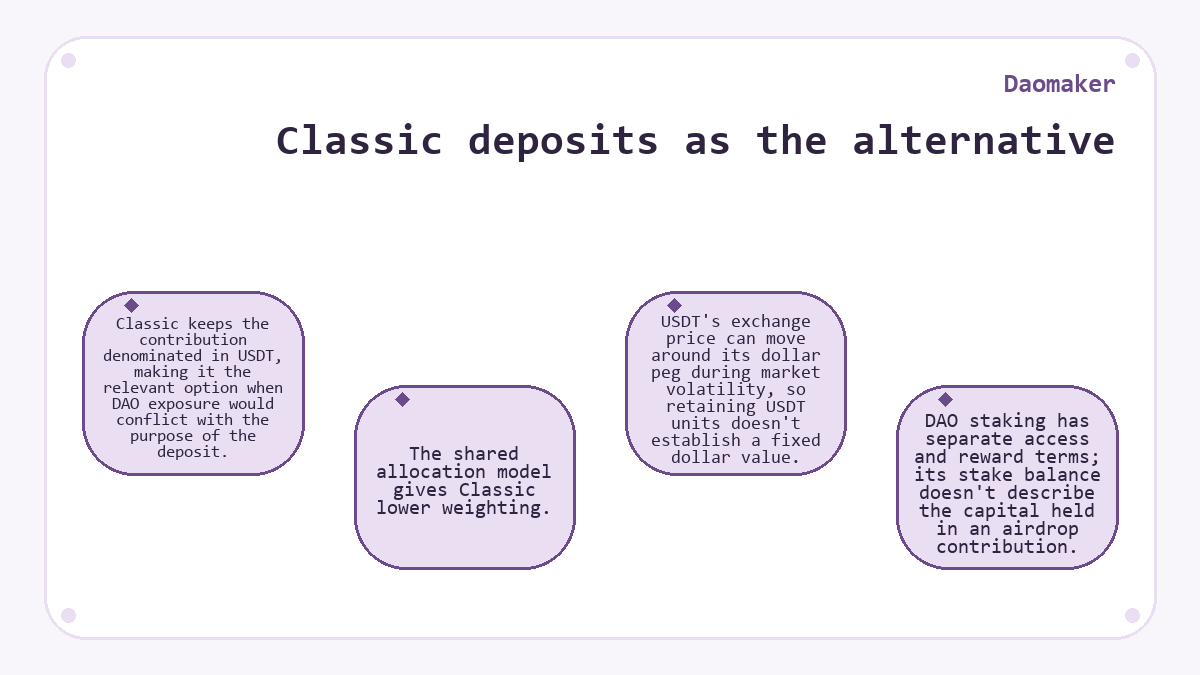
Classic keeps the contribution denominated in USDT, making it the relevant option when DAO exposure would conflict with the purpose of the deposit. The shared allocation model gives Classic lower weighting. USDT's exchange price can move around its dollar peg during market volatility, so retaining USDT units doesn't establish a fixed dollar value. DAO staking has separate access and reward terms; its stake balance doesn't describe the capital held in an airdrop contribution.
Project-specific token release schedules
Project-token release follows the campaign's unlock terms, independently of the contribution-return date. The token generation event, or TGE, is the reference event for the initial release. Vesting spreads later portions over the specified schedule. Unio Coin's airdrop terms specify a 5% release at TGE followed by 24 months of linear vesting. Cyclean's airdrop terms specify 5% at TGE followed by 19 months of linear vesting.
Both schedules leave most of the airdrop allocation outside the initial TGE release. A participant can recover the contribution while project tokens remain subject to their unlock schedule. Sale and airdrop allocations can also carry different release terms within the same project. A campaign's advertised airdrop amount consequently doesn't describe how many tokens one participant can immediately receive.
When does identity verification matter?
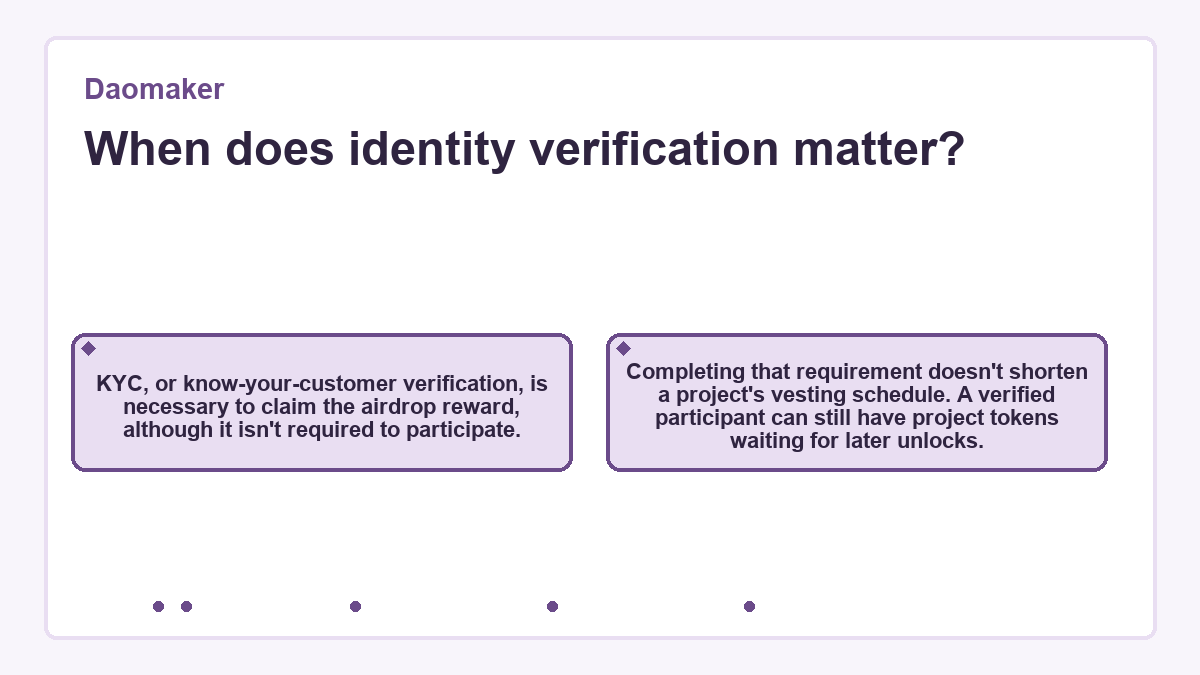
KYC, or know-your-customer verification, is necessary to claim the airdrop reward, although it isn't required to participate. Completing that requirement doesn't shorten a project's vesting schedule. A verified participant can still have project tokens waiting for later unlocks.
Questions and answers about Daomaker
Can DAO Power add weight to an airdrop Boost allocation?
DAO Power doesn't enter the public-offering calculation that the airdrop system shares. That calculation uses contributed amounts and allocation shares. DAO Power has a separate role in private offerings, so increasing a staking balance shouldn't be treated as an additional weight for an airdrop Boost contribution.
Which network does Unio Coin use for its airdrop?
Unio Coin's airdrop terms specify Base for distribution of its project tokens. That setting concerns the airdrop reward, while Boost converts the participant's contribution into DAO. The project-token network and the contribution's conversion mechanism describe separate parts of participation.
How do Unio Coin's sale unlocks differ from its airdrop unlocks?
Unio Coin's sale terms specify 25% at TGE, a three-month cliff and nine months of linear vesting. Its airdrop terms specify 5% at TGE followed by 24 months of linear vesting. The sale timetable therefore doesn't determine when an airdrop participant can claim the remaining project tokens.
Can a larger Boost allocation offset a fall in DAO's value?
Project tokens can offset a DAO valuation loss if their realizable value covers that loss after relevant costs. Allocation weight alone doesn't establish that outcome. A locked reward isn't yet available through its scheduled claim, so release timing and the value obtainable for available tokens both affect the comparison.
Updated: