 Daomaker
 hosts public token sales and connects private allocations with DAO staking
Daomaker is a crypto launchpad with public token sales, private offerings for DAO stakers and DAO staking rewards. Its launchpad uses SHOs, or Strong Holder Offerings, to allocate project tokens. Public and private offerings use different participation models. A 5% platform fee applies to each round that a participant chooses to claim, with the deduction coming from tokens. A purchase can include a refund option, while airdrops, farms and vaults extend the platform beyond sales.
Bottom line: The 5% platform fee comes from claimed allocation tokens, so the gross allocation differs from the tokens received.
Launchpad sales and DAO staking
The launchpad allocates project tokens through sales, while DAO staking supports access and rewards tied to the platform's own token. Staking commits DAO under its staking terms, and purchasing a project's tokens requires a separate sale contribution.
DAO Power measures a participant's weight in private allocations. Public sales apply a separate allocation system, so staking for access and contributing to a sale serve different purposes.
How are public sale deposits allocated?
Public sales allocate contributions through deposit shares, with a classic USDT option and a DAO Boost option. Classic deposits use USDT, while DAO Boost converts USDT into DAO through PancakeSwap V3 and gives the deposit greater allocation weight. DAO Power doesn't enter the public allocation calculation.
The allocation reflects the target raise and contributions across the sale. Unused classic USDT returns automatically after the offering. The boosted route requires a manual claim of unused DAO.
Private allocation and lottery options
Private offerings combine DAO Power with contributed DAO, using a guaranteed-allocation option and a weighted lottery.
Guaranteed allocation
Guaranteed allocation reflects a participant's DAO Power relative to the total registered power. The target raise and the offering's guaranteed ratio also affect the share.
Contribution within the allowance
A calculated allowance doesn't fund itself, so the contribution limits how much of that allowance the participant can actually take.
Contribution above the allowance
The excess-allocation component distributes remaining capacity across contributions above guaranteed allocations. Excess deposits return when the offering ends.
Weighted lottery
The lottery uses deposits in multiples of its ticket size, with weighting that determines winning chances. An off-chain calculation produces the winner list, which the smart contract then verifies.
DAO Power and future token unlocks
DAO Power influences private offering allocations and can remain a condition for receiving later vested project tokens.
Staking supplies base power, and multipliers can increase the resulting private-sale measure. DAO Boost contributions in public offerings can also supply power while the relevant DAO remains deposited. That power supports private allocations even though it doesn't determine the allocation in the public sale.
Dropping below the DAO Power used for a private offering can affect that project's future token unlocks. The Strong Holder Offering rule allows three days to restore a shortfall. Missing that grace period forfeits future unlocks for the affected project. The forfeiture concerns that project's future vested tokens, while staking principal follows the withdrawal rules for its own position.
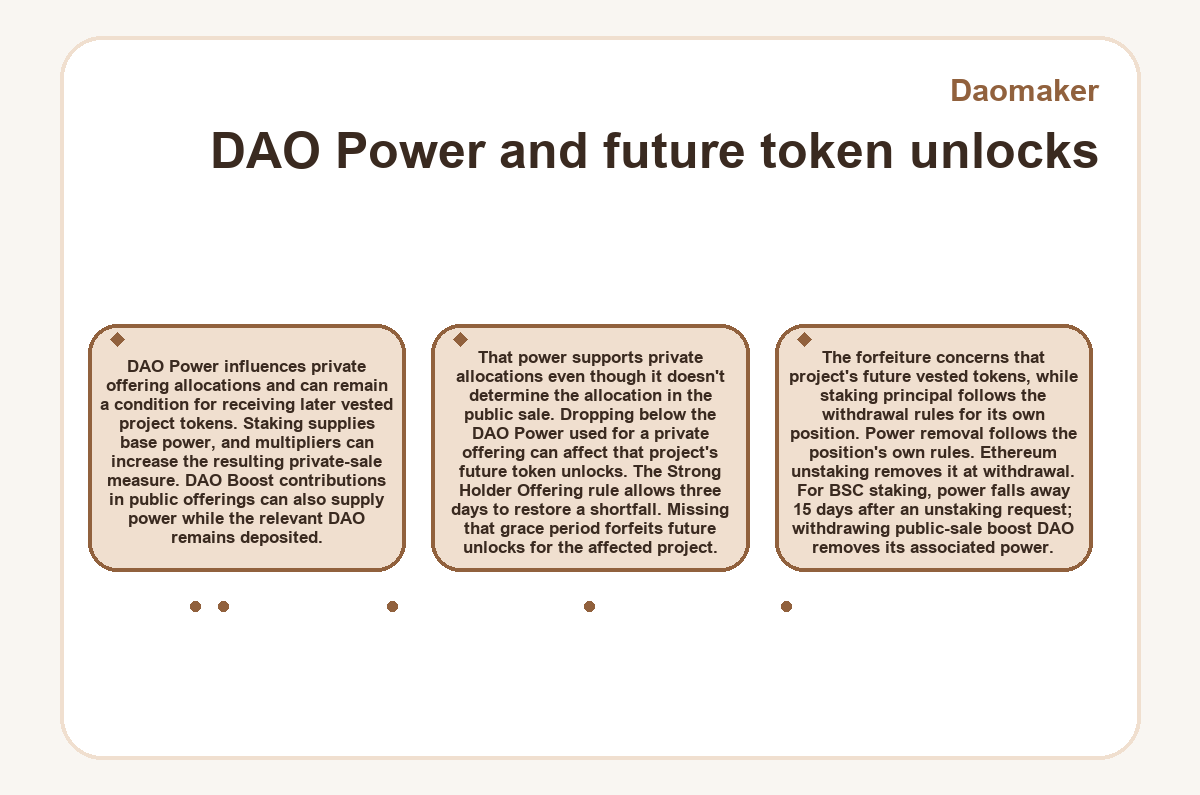
Power removal follows the position's own rules. Ethereum unstaking removes it at withdrawal. For BSC staking, power falls away 15 days after an unstaking request; withdrawing public-sale boost DAO removes its associated power.
Where does the 5% platform fee apply?
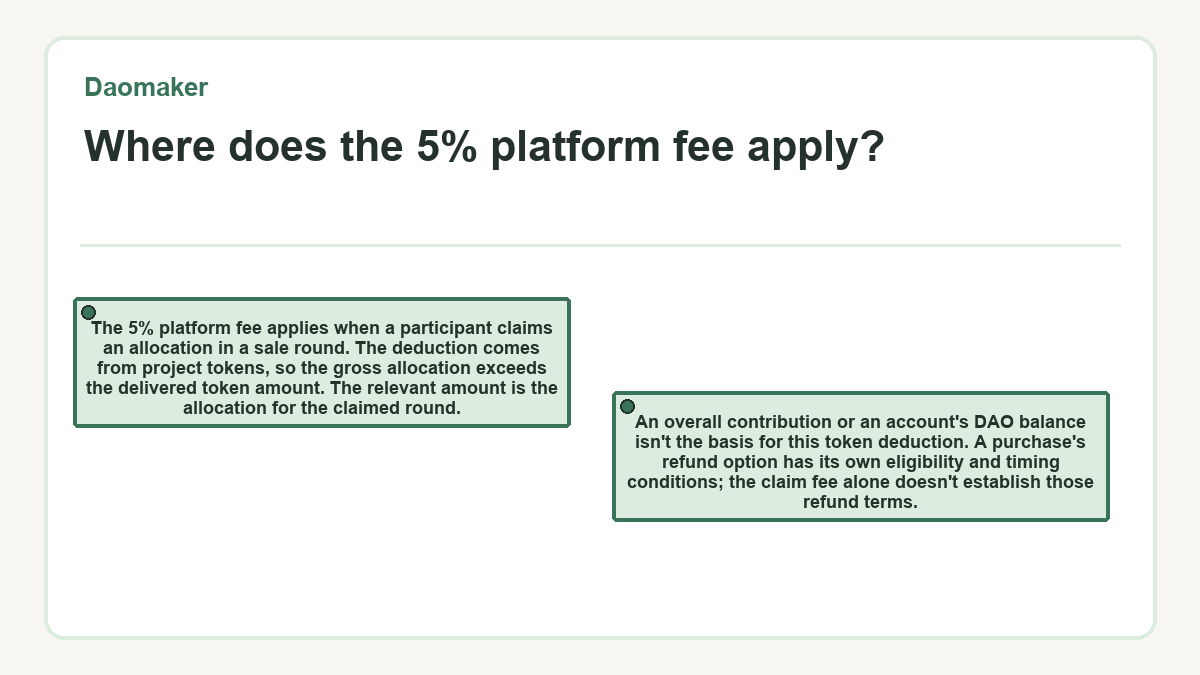
The 5% platform fee applies when a participant claims an allocation in a sale round. The deduction comes from project tokens, so the gross allocation exceeds the delivered token amount.
The relevant amount is the allocation for the claimed round. An overall contribution or an account's DAO balance isn't the basis for this token deduction. A purchase's refund option has its own eligibility and timing conditions; the claim fee alone doesn't establish those refund terms.
Staking terms across supported networks
DAO staking spans Ethereum, BSC and Solana, with withdrawal rules that differ by network and position. Ethereum staking offers commitments from 30 to 1,095 days. An initial 15-day hard lock prevents withdrawal. Later early unstaking can incur fees that reduce rewards and, in some cases, principal.
BSC uses an unstaking request followed by a 15-day cooldown, with a 15% stake penalty for leaving before that period ends. Solana staking follows the BSC settings. Obtaining DAO Power on Solana also requires signatures from the participant's Solana and BSC wallets to connect them in the profile.
How do airdrops differ from token sales?
Airdrops use the public allocation system to distribute project tokens while returning the contribution after the airdrop period. Classic participation returns USDT automatically. Boosted participation converts the deposit to DAO and requires a manual DAO claim at the end.
Returning all the contributed DAO doesn't ensure the same USDT value, because the exposure changed during conversion. A token sale uses the allocated contribution to fund a purchase and returns the unused portion. An airdrop returns the contribution, while project-token claims follow the project's token generation event.
Farms and vaults alongside the launchpad
Farms present project reward pools, while vaults support staking DAO and tokens associated with the vault. Their terms govern participation separately from a launchpad purchase.
Contribution choices and withdrawal conditions
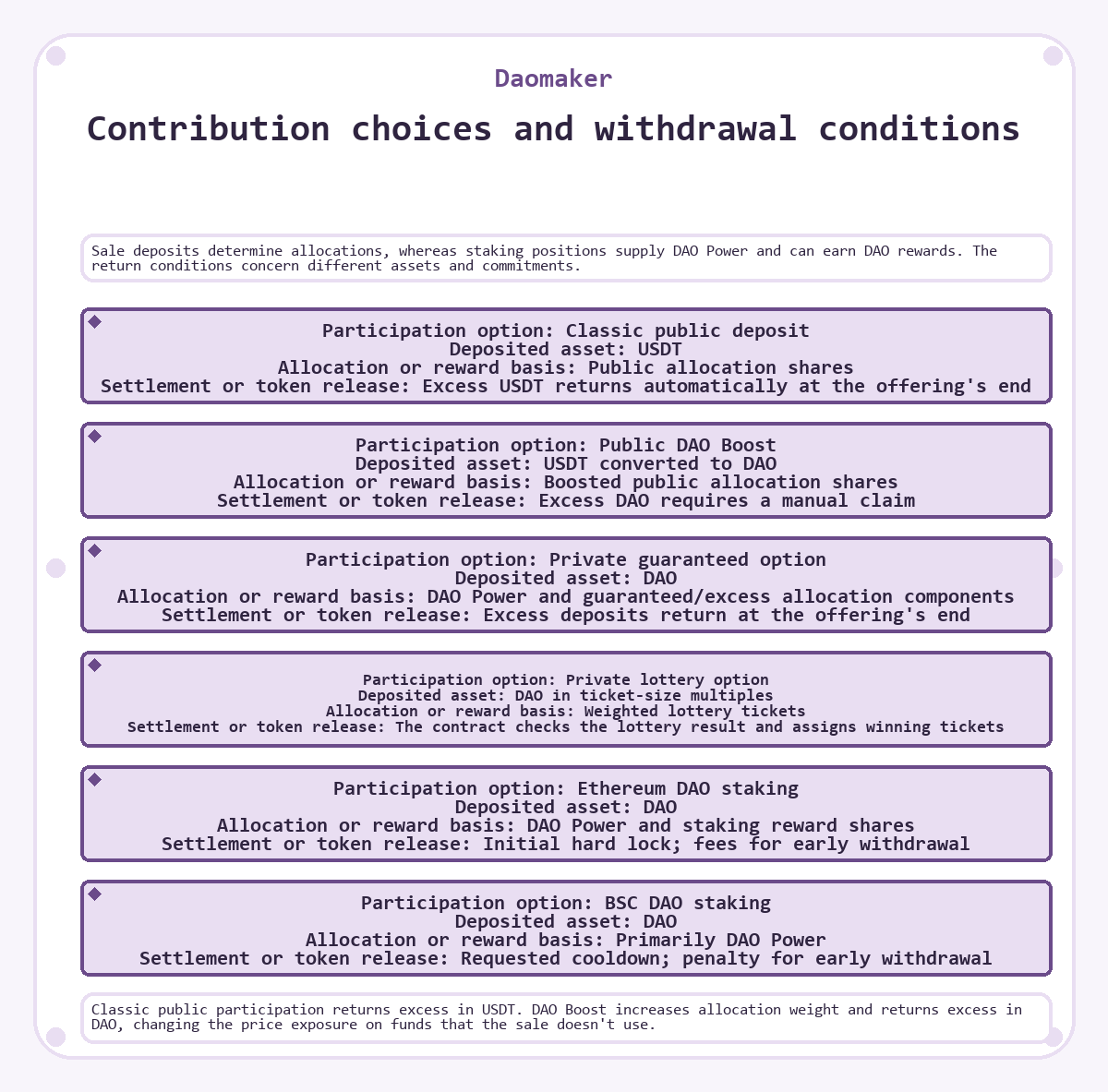
Sale deposits determine allocations, whereas staking positions supply DAO Power and can earn DAO rewards. The return conditions concern different assets and commitments.
| Participation option | Deposited asset | Allocation or reward basis | Settlement or token release |
|---|---|---|---|
| Classic public deposit | USDT | Public allocation shares | Excess USDT returns automatically at the offering's end |
| Public DAO Boost | USDT converted to DAO | Boosted public allocation shares | Excess DAO requires a manual claim |
| Private guaranteed option | DAO | DAO Power and guaranteed/excess allocation components | Excess deposits return at the offering's end |
| Private lottery option | DAO in ticket-size multiples | Weighted lottery tickets | The contract checks the lottery result and assigns winning tickets |
| Ethereum DAO staking | DAO | DAO Power and staking reward shares | Initial hard lock; fees for early withdrawal |
| BSC DAO staking | DAO | Primarily DAO Power | Requested cooldown; penalty for early withdrawal |
Contribution choices and withdrawal conditions
- Participation option: Classic public deposit Deposited asset: USDT Allocation or reward basis: Public allocation shares Settlement or token release: Excess USDT returns automatically at the offering's end
- Participation option: Public DAO Boost Deposited asset: USDT converted to DAO Allocation or reward basis: Boosted public allocation shares Settlement or token release: Excess DAO requires a manual claim
- Participation option: Private guaranteed option Deposited asset: DAO Allocation or reward basis: DAO Power and guaranteed/excess allocation components Settlement or token release: Excess deposits return at the offering's end
- Participation option: Private lottery option Deposited asset: DAO in ticket-size multiples Allocation or reward basis: Weighted lottery tickets Settlement or token release: The contract checks the lottery result and assigns winning tickets
- Participation option: Ethereum DAO staking Deposited asset: DAO Allocation or reward basis: DAO Power and staking reward shares Settlement or token release: Initial hard lock; fees for early withdrawal
- Participation option: BSC DAO staking Deposited asset: DAO Allocation or reward basis: Primarily DAO Power Settlement or token release: Requested cooldown; penalty for early withdrawal
Classic public participation returns excess in USDT. DAO Boost increases allocation weight and returns excess in DAO, changing the price exposure on funds that the sale doesn't use.
Things people ask about Daomaker
Can project founders apply to launch through Daomaker?
Project founders can apply to join the launchpad's ecosystem. The platform provides an application entry point alongside its project listings. Submitting an application doesn't establish acceptance, a fundraising allocation or a launch date.
Does a farm's reward pool show one participant's payout?
A displayed reward pool describes the pool's token amount. It doesn't specify the allocation owed to a particular participant, so the total shown in a project listing shouldn't be read as an individual entitlement.
Do I need identity verification before joining an airdrop?
The airdrop system requires identity verification to claim reward tokens, though it doesn't require that verification for participation.
Why can identical DAO stakes earn different Ethereum rewards?
Ethereum rewards depend on staking shares and each day's reward pool. Commitment length and the share rate when staking begins affect shares, while daily pool funding changes rewards per share. Equal DAO amounts therefore don't establish equal reward totals.
Which networks can host vaults?
Vaults mainly target BSC, with possible vaults on Ethereum or Solana. That broader possibility doesn't establish that a particular vault runs on every network; its network and supported tokens define the available staking option.
What does ATH mean in the launchpad project listings?
ATH means all-time high. A historical multiplier describes an earlier peak; it doesn't establish a current token price or the return that an individual participant realized. The listing's historical performance and a participant's sale allocation describe different quantities.
Are public-offering shares the tokens that I claim?
Public-offering shares measure allocation weight. A claim delivers the offering project's tokens, so deposit shares and the project-token allocation represent different quantities.
Updated: